

On Martyrdom
Minneapolis, Dorothy Stang, and The Stranger

On this day 21 years ago, Dorothy Stang - a 73-year-old Catholic nun born in Ohio - walked a muddy track in the Brazilian state of Para, not far from where COP30 was held last year. Two pistoleros (gunmen) were waiting for her. From the cloth bag at her waist she pulled out a Bible and read aloud:
Blessed are those who hunger and thirst for justice, they will be satisfied.
She got only a couple of Beatitudes out before they shot her six times and left her for dead.
One could very easily imagine her saying, “That’s fine, dude. I’m not mad at you.”
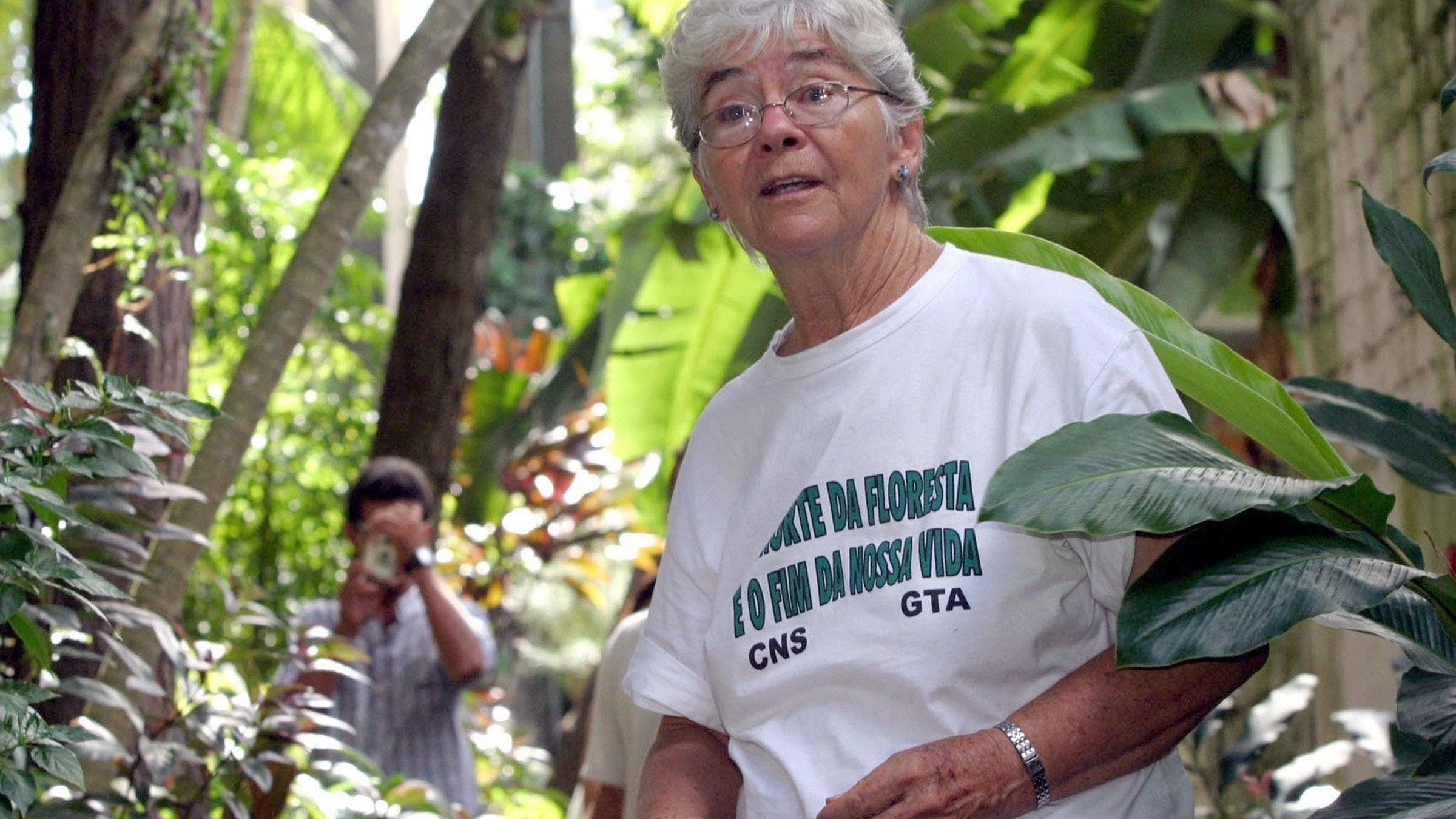
The scene almost resists further comment. But it does deserve remembering, and that remembrance needs words.
The Ancient Greek word martys means “witness”. A ‘martyr’ in the original sense is just that. Not a showboater, or a symbol, or a suicide bomber. Someone who refused to look away and stop telling the truth as they saw it. To bear witness, and to refuse to assume it was someone else’s job.
Martyrdom can feel morally suspect to modern Western minds, because it’s become associated with someone actively seeking death - literal annihilation being the final state of nihilism. It’s far from new. Augustine, 1600 years earlier, wrote and spoke against seeking death as dramatic spectacle. Aquinas was even clearer: suicide by ideology is still suicide. Martyrdom is the acceptance of suffering or death rather than betraying the truth or care for others.
Which brings us, however uncomfortably, to Minneapolis.
In January two other Americans - Renee Good and Alex Pretti - were killed in separate encounters with federal paramilitary agents on the streets of Minneapolis.
Pretti was an ICU nurse who tended to veterans, often in their final moments, noted by colleagues for his insistence on honouring his patients who had served and sacrificed. Just a few words and quiet reflection at the hour of their deaths. He was shot 10 times in the back while on his knees after being blinded with pepper spray, while filming agents and putting his body between them and a female observer they were attacking.
He felt called to come out to observe ICE after, just two weeks earlier and a few blocks away, 37-year-old mother of three Renee Good was shot point blank as she tried to drive away. Recorded on her killer’s body cam, her last words were, “It’s fine, dude. I’m not mad at you.”
Both were initially slandered as “domestic terrorists” but seen as so grotesquely ridiculous that their memories urgently needed to be discredited in some other way.
Enter Ron Johnson, senator from neighbouring Wisconsin, voice dripping with bile and dismissal: “They got their martyrs.”
Which begs the question: who gets to decide who is a martyr?
Augustine wrote at a time when the question wasn’t theoretical either.1 He argued that it’s right to want to understand motive and state of mind. Did the person die for truth, or pride? Love of others, or spectacle?
Aquinas was more forensic and anticipates the Johnson critique 800 years earlier. That anyone who puts themselves in harm’s way is either a dupe manipulated by others or a lunatic, neither of which is worthy of respect.2 Death is not the objective, the need to keep the faith is - faith to others, to the truth.
Last year Sister Dorothy became the first woman to be honoured as a recent martyr of the Americas, at a ceremony at a shrine in St. Bartholomew in the Tiber, in Rome.
She didn’t go on that road to die.
Stang dedicated four decades of her life to the poor and the meek in Amazonia. As Pope Leo did in Peru during his four decades there, she became a dual citizen of Brazil. She became an outspoken advocate for the poor farmers, working to help them sustainably farm in the Amazon and living with them in a village off the (unpaved) trans-Amazonian “highway” when in 1972 the Brazilian government offered them the chance to own and farm their own land.
A picture of Oscar Romero hung on the wall of her hut in later years, a detail noted by a BBC reporter not long after her murder.
All four: the assassinated Salvadoran bishop Oscar Romero, Sister Dorothy Stang, Renee Good, and Alex Pretti, had something in common. All of them felt that their neighbours deserved to be treated as human beings with inherent dignity and that thugs, in or out of uniform, acting on behalf of the powerful should be resisted. Even at the ultimate cost.
But it’s important to remember that martyrdom isn’t a goal that anyone wants. Because the intent of wanting it would render the person not a martyr. It’s right and just to honour the martyr but equally to encourage the people who, just like Pretti and Good, simply refuse to stop bearing witness, to love their neighbour, and not to betray the truth.
People like the Discerning Deacons, a network of Catholic women in Minneapolis active in providing mutual aid, legal support, and prayer to migrant neighbours under siege in their city. Or Laura Kelly Fanucci, who spoke for many in expressing her disappointment at the reluctance of priests in Minneapolis pulpits to more clearly connect the Gospel to the crisis all around them - in between runs to deliver food and medicine to people afraid to go outside. Or the 100+ clergy who got themselves arrested last month, hours before Pretti was shot, for non-violently blocking access to the local airport for deportation flights. Or those from all faiths and none who put themselves at risk of punishment for bearing witness for their neighbour, the natural world that sustains life, or the truth itself.
We shouldn’t want them to become martyrs - and we don’t. They shouldn’t want to become martyrs - and they don’t. But it is not wrong to honour those who, like those in Alex Pretti’s care, did risk it all for something larger than themselves and who are rightly called martyrs.
Romero and Stang spoke up for the poor and indigenous in Latin America and (for Stang especially) the environment and climate of Creation on which their futures depend. Good and Pretti for their neighbours, especially the migrant and ‘the stranger’. No one - especially not those in power - believes that the climate-impacted century ahead of us will see less migration.
How to engage with the inherent dignity of humans who migrate and come among us is the central moral and spiritual question of this century. More acute now but has always been there.
And over and over again through the centuries wisdom traditions have more or less aligned on two ideas: that it’s pretty normal to distrust and fear and scapegoat the stranger; and that it is an instinct that can and should be overcome because that is what we are called to do to be fully human, which cannot be achieved without a raw empathy for others.
That’s why the Beatitudes that Sister Dorothy spoke while being killed are so dangerous. They turn the world upside down. The meek, the poor in spirit, the persecuted are the winners. Real power lies in faith to that truth under pressure.
That’s why tyrants cannot abide the continuing existence of people who bear witness to that truth. So give a thought to Sister Dorothy and those who came before her and after, including in Minneapolis.
The Stranger
A viral clip doing the rounds is Sir Ian McKellen talking with Stephen Colbert about theatre and performing Shakespeare. McKellen then launches into a speech written by Shakespeare for the character of Sir Thomas More. More is, in this suppressed play Shakespeare co-wrote, sent to quell an anti-immigrant riot in 16th-C London. Watch the whole thing, including the intro (which let’s get into below):
That McKellen’s hand shakes as he reaches for the cup on the desk, that last year he fell off the stage for a play I was meant to see in London’s West End, that his steps are so unsteady now, made his performance at 86 years old that much more poignant.
Catholics consider Thomas More a saint and martyr. So it’s not entirely surprising that a text portraying him in such a sympathetic light might have been suppressed for 350+ years before being performed in England. As a Hilary Mantel fan I found her Thomas Cromwell to be far easier to identify with3 than the priggish, dickish, cruel, kindof weird Thomas More she portrays (brilliantly realised by Anton Lesser in the BBC dramatisation).
More wasn’t martyred for that speech, of course. But in light of the (really bright neon-glaring) signs of the times it’s worth thinking about.
Back soon.
Rome had just been “sacked” by Alaric and the Goths. “Sacked” sounds bloodless now but was a term that took longer to lose its power to shock than the “insurrection” in Washington on 6 January 2021 but the psychic cultural effect is closest. One could equally of not more plausibly argue for the 9/11 attacks as being comparable in their effect of unmooring the assumptions of an entire civilisation.
During the ‘sack’ of Rome, numerous Christian women had suffered sexual violence. Many later committed suicide. Augustine argued it was wrong to praise or encourage those suicides as somehow about preserving ‘honour’ or ‘virtue’. Their lack of consent meant they were blameless. And, implicitly, every man around those women owed them every affirmation of that truth. It must be acknowledged, as Augustine does implicitly, that far too few did - and I’d like to think that’s why the story is so prominent and so emotive in the first part of City of God.
That will come as news to the wounded veterans Alex Pretti served, but never mind.
If you hear Thomas Cromwell described as “Alastair Campbell with an axe” and you think, ‘yup I know this guy [tries to avoid mirror] cool tell me more’ (even if you know that’s sick and wrong) I’m your guy. If not you may find this harder to hear. But Mantel’s Cromwell is so thoroughly recognisably modern in his worldliness, his pragmatism, his sheer refusal to be bound by others’ expectations - followed by his fall across the subsequent two novels by the ultimately futile effort to accommodate oneself to power to make oneself safe - is something I come back to a lot.